
[Process] Tidal Power

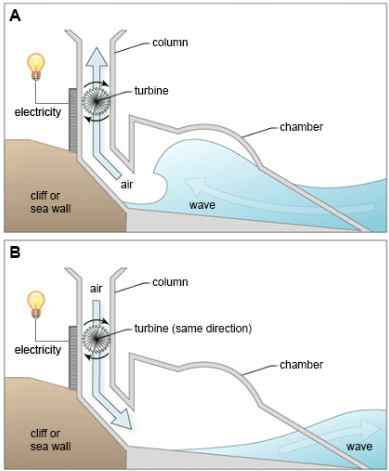
The diagrams show a structure that is used to generate electricity from wave power.
Overview:
- Cấu trúc chính của máy: có 4 bộ phận
- Cách hoạt động: có 2 cách tạo ra điện
Body 1: Cấu tạo
- Chamber, Column, Turbine, Grid
- Được xây gần vực hoặc mặt biển
Body 2: Cách hoạt động:s
- Khi thủy triều dâng lên -> sóng đánh vào cấu trúc chính -> đẩy khí ra khỏi ống thoát và xoay tua bin -> tạo ra điện.
- Khi thủy triều rút -> sóng rút theo và rời khỏi cấu trúc chính -> khí từ ngoài được hút vào khi nước rút và điều này cũng làm tua bin xoay, tạo ra điện.
| Sample | Vocabulary |
| The provided diagram gives a visual description of how electricity can be created from a tidal generator. Overall, it can be seen that this contraption consists of 4 main parts and energy can be formed via two main ways depending on the position of the tide. Regarding the main components, this structure is made up firstly of a main chamber, which holds the tide. In addition, attached to this chamber is an elongated column that houses a turbine connected to an electrical grid. One special feature of this structure is that it is built along cliffs or sea wall. Moving on to its operation, we can see that energy can both be generated when the tide flows in and ebbs. During flood tide, water rushes into the chamber, pushing the air inside the construction up the the column and spinning the turbine, producing power. Conversely, when the tide recedes, air from the outside enters the column to displace the lost water leaving the chamber and in the process spinning the turbine. As the turbine is designed to spin in the exact same direction, electrcity can also be formed this way. | Contraption (n): device, machine Components (n): partsElongated (adj): made longer and thinner (than something else) Ebb (v/n): tide moving back into the ocean Recede (v): moving back, withdrawing, retreatingConversely (adv): in contrast Displace (v): replace |



Responses