
[Process] Cheese making process

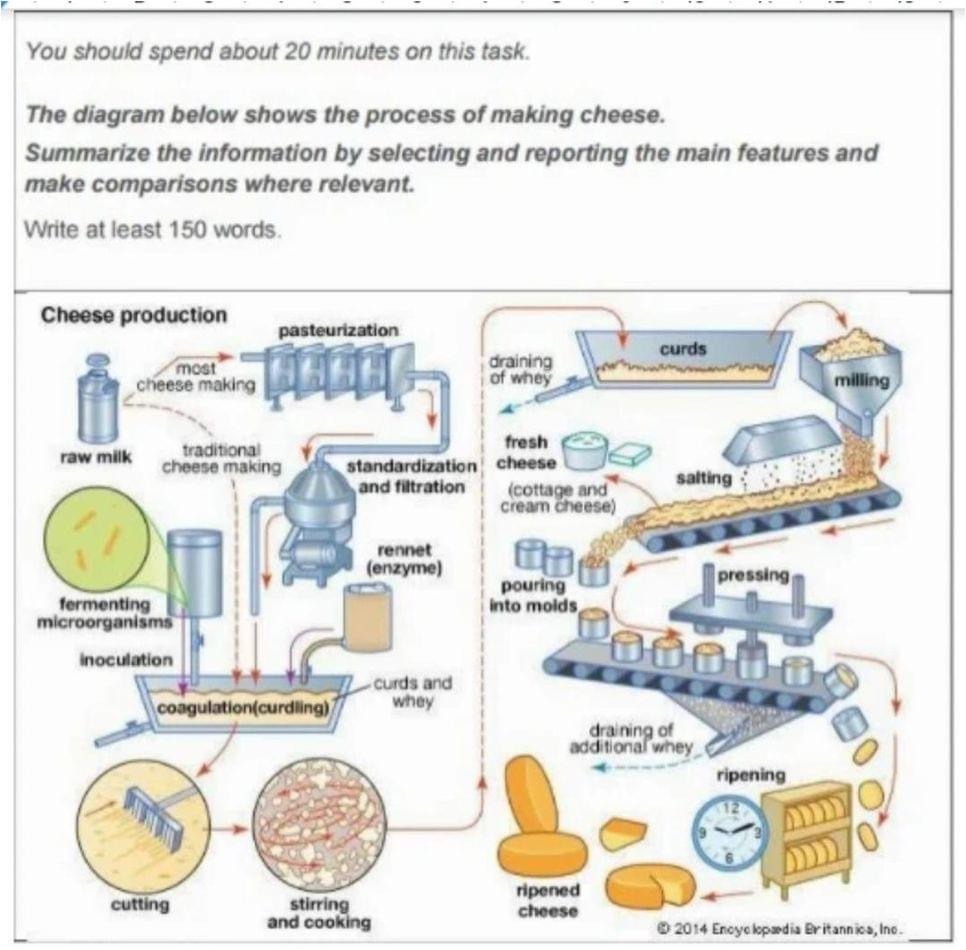
The given diagram describes the stages of cheese manufacturing. Overall, it can be seen that this is a process with around 11 steps, commencing with raw unprocessed milk and culminating with ripened cheese.
To start off, for the majority of contemporary cheese making procedures, raw milk first goes through pasteurization and then standardization as well as filtration before entering coagulation or curdling. However, for conventional cheese making, the first 2 steps are skipped, and raw milk goes straight through to curdling. Regardless of the methods, during coagulation, fermenting microorganisms from inoculation are combined with rennet ,or enzyme, alongside the milk. The resulting mixture is then cut, stirred and cooked in order to make curds.
After being drained of whey, the curds are put into a machine where they are milled and then dumped onto a conveyor belt on which salting occurs. At the end, the salted substance can either be used as fresh cheese, or cottage and cream cheese, or poured into molds to embark on an additional stage for ripened cheese. In the following stages, the molds are pressed to drain any additional whey before spending some time on shelves for ripening to make ripened cheese.




Responses